
Food for Thought
The First Generation Whose Bodies Are Being Rewritten
Climate Change and Our Children’s Health
Climate change is usually measured in weather, damage and cost. A growing body of research measures it somewhere else: in how children’s bodies are built.
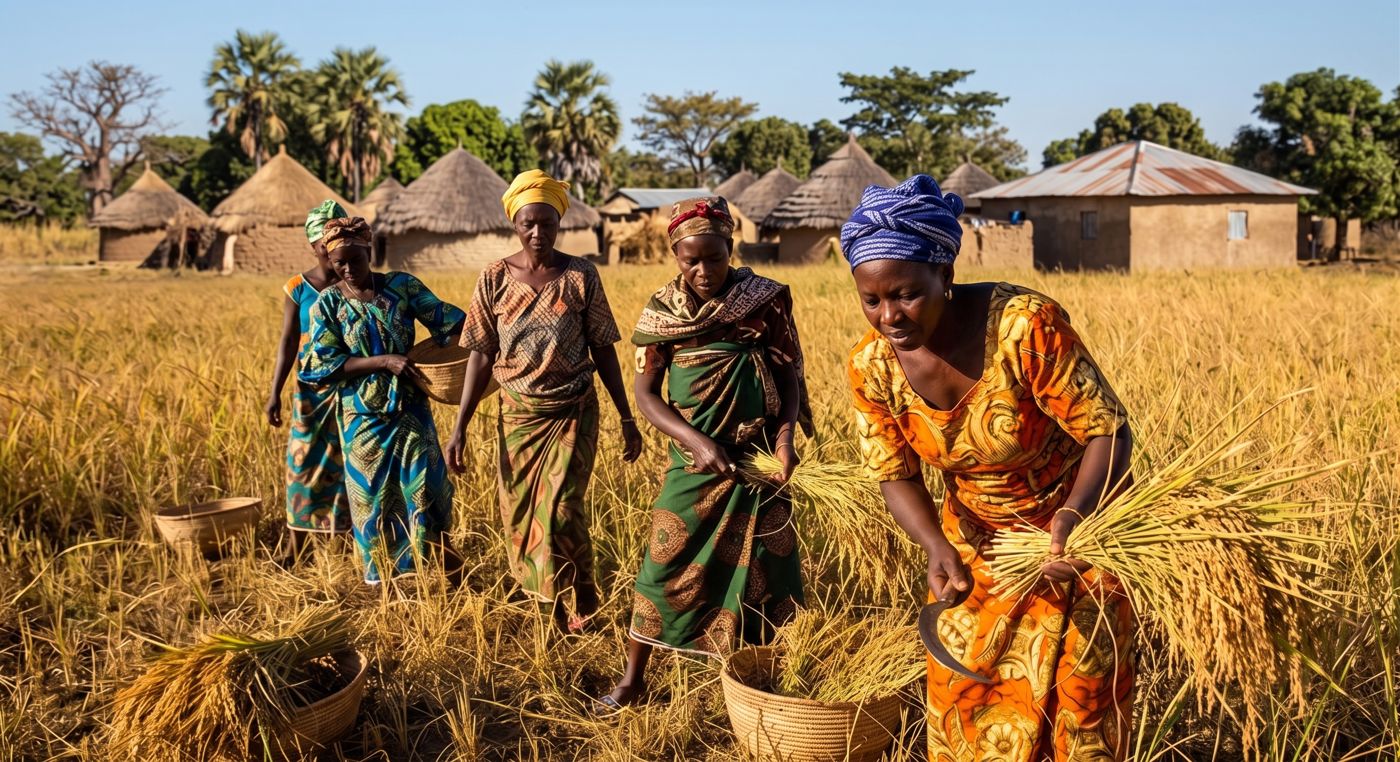
In the fields of West Kiang, in rural Gambia, pregnant women farm through the hot season because the work does not wait. In 2019 and 2020, researchers carried a portable ultrasound device into those fields and followed ninety-two of them. They watched the babies while the mothers worked — something rarely done before.
The heat index — which combines temperature and humidity — averaged 34°C. Roughly one in three readings showed signs of fetal distress: heart rates above the study's threshold of 160 beats per minute, and greater resistance to blood flowing through the umbilical cord.
The mechanism is not complicated. Pregnancy already runs the body hot. Blood volume rises by as much as half, and the developing baby generates heat of its own with nowhere to send it except through the mother. When outside heat overwhelms her capacity to cool herself, her body makes a decision that every mammal's body makes: it protects its own core organs first. Blood is pulled away from the womb. The placenta gets less.
That was not a projection about 2050. It was a measurement, taken on a machine, published in a medical journal.
Climate change usually reaches the news as floods, fires and what they cost. This is the quieter version. A warming atmosphere can change how children develop from pregnancy onward — sometimes slightly, sometimes permanently.
Before the first breath
The Gambian study shows the mechanism in individual pregnancies. Population studies show how often it happens.
The most comprehensive review to date pooled 198 separate studies from 66 countries. The odds of premature birth were about 4% higher for each additional degree of heat exposure during pregnancy, and 26% higher during a heatwave.
A single-city study makes the same point at higher resolution. Researchers in Sydney examined more than 1.2 million births. Extreme heat during the final three months of pregnancy was associated with 61% higher odds of premature birth.
The same study found something about the night that deserves more attention. Extreme nighttime heat raised the odds by 51% — nearly as much as daytime heat. We tend to picture heat as a daytime hazard we shelter from and then recover from after dark. But blood pressure normally falls during sleep, and heat that never breaks after sunset prevents that drop. For a pregnant woman without air conditioning, the hot night may matter as much as the hot afternoon.
Premature birth is not a minor outcome. It is among the leading causes of death in children under five worldwide, and children born early carry elevated risks for respiratory and developmental problems well into life.
Lungs that never finish growing
A child's lungs are not finished at birth. They keep building air sacs and blood vessels into adolescence. Children also breathe faster than adults relative to their size, so they take in more of whatever is in the air — during exactly the years the organ is still under construction.
Wildfire smoke is not simply more of the pollution cities already have. It contains a different mix of chemicals from burnt vegetation, and it affects the immune cells deep in the lungs more strongly than ordinary urban pollution does.
The clearest evidence comes from southern California. In San Diego County, for the same amount of particle pollution, wildfire smoke was associated with an increase in children's respiratory medical visits about eight times as large as the increase associated with ordinary urban pollution. The effect was strongest in children under five.
Whether that eightfold estimate applies elsewhere is uncertain. Independent research keeps finding wildfire smoke more damaging than ordinary particulate pollution — a large multi-country study in 2025 found it worse across every major respiratory category examined. But the size of the gap varies. One major US analysis of long-term mortality put it at around five times as toxic. The estimates approaching tenfold come from the same research team in the same region, so they do not provide independent confirmation.
What can be said safely: wildfire smoke is substantially more harmful to children's lungs than ordinary air pollution, plausibly several times over and possibly much more for asthma. The exact factor depends on where you measure and what you count.
For readers in Canada and the northern United States, this has stopped being a story about somewhere else. Recent summers have put smoke from distant fires over cities that had never planned for it, on days when schools stayed open and children played outside.
An asthma attack passes. Reduced lung growth can persist into adulthood. Children exposed year after year appear to end up as adults whose lungs simply hold less air. From outside, the two harms look alike. They are not the same thing.
The brain, physically altered
Reports often blur two different things: temporary drops in test performance, and structural differences in the brain.
Children score worse on tests during heatwaves. That is well documented and temporary — a hot brain performs badly, then recovers, the way a tired one does. A real cost, but a passing one.
The research below is about the second kind: brains built differently, visible on a scan.
In Rotterdam, researchers scanned 783 children from a long-term birth study, comparing each scan against estimates of the air their mothers had breathed while pregnant. Children whose mothers had been exposed to more fine particulate pollution had a measurably thinner cerebral cortex — the brain's outer layer — in specific regions involved in attention and self-monitoring.
A separate study scanned nearly 12,000 American adolescents. Pollution exposure at ages nine and ten was linked to changes in white matter — the tissue carrying signals between brain regions — in the networks that govern attention and impulse control.
Food that feeds less
Extra carbon dioxide in the atmosphere makes many plants grow faster. This is not the good news it sounds like. Under higher carbon dioxide, plants produce starch and sugar faster but do not absorb soil minerals any faster. The result is dilution — more bulk, the same minerals, spread thinner.
A landmark analysis pooled 7,761 measurements across 130 crop varieties grown under elevated carbon dioxide in open fields. Mineral concentrations — including zinc and iron — fell by about 8%.
The crops affected are the ones most of humanity lives on: wheat, rice, barley, potatoes, legumes.
For a child, the same amount of food can provide less iron and zinc for growth. Iron deficiency causes anaemia and impairs cognitive development. Zinc deficiency weakens immune response and stunts growth. Neither shows up as hunger. A parent doing everything right, feeding a child the same staple their family has eaten for generations, cannot see it.
Researchers tested whether field-grown plants compensated by absorbing more minerals from the soil. In general, they did not. Debate continues among agricultural scientists over whether targeted fertilisation or crop breeding could offset the loss without sacrificing yield.
Diseases climbing the mountains
Mosquitoes cannot regulate their body temperature. The viruses they carry also develop faster or slower depending on the air temperature. For most of human history, cold is why mountain valleys were safe from tropical disease.
That barrier is lifting. The Hindu Kush Himalaya is warming by about 0.1°C per decade, and dengue fever — historically a lowland, tropical disease — has moved uphill into Nepal's mid-hills. In 2022, the country recorded 54,784 cases spread across all 77 districts, including places with no history of the disease.
In places where dengue has not circulated, nobody has prior immunity, and infants receive no dengue antibodies from their mothers either. A first outbreak meets a population with no defences at all, and severe dengue is dangerous in a young child.
Researchers disagree about how far up the mountains the disease has actually reached. Cases are recorded by administrative district, and a Himalayan district's average elevation includes a great deal of uninhabited mountain. People live in the valleys. Measuring transmission against district averages, some geographers argue, makes dengue look higher up the slopes than it is. The direction of movement is not disputed. The altitude is.
Why children, specifically
Children are especially vulnerable because of their size, their immature sweat response and their faster metabolism.
A small body has more surface area relative to its mass, so it absorbs heat from the environment faster. Children's sweat glands are not fully developed, so they cool themselves less efficiently. Their metabolisms run faster, generating more internal heat to begin with. Every mechanism points the same direction.
Newborns are the extreme case. They cannot move into shade, remove a layer, or ask for water. A study of more than three million births in São Paulo state found that babies delivered during the hottest conditions were 8% more likely to have a low Apgar score — the routine check of a newborn's condition in the minutes after birth.
The physiology is universal. The exposure is not. A child in an air-conditioned house and a child in a tin-roofed room face the same summer with entirely different protection. The women in the Gambian fields had no option of staying home.
What works, and what doesn't
The research is not only an inventory of harm. Some of it is unusually practical.
Paint. In informal settlements, tin and concrete roofs act as ovens, pushing indoor temperatures above the outdoor high. Coating them with reflective white paint lowers indoor temperature by 2 to 7°C, starting the day it is applied. It requires no electricity, no maintenance and no technology. After a 2010 heatwave killed more than 1,300 people, Ahmedabad in western India built South Asia's first municipal heat action plan, with cool roofs among its measures — a model that has since spread to other Indian cities.
Trees. The Sydney researchers checked something few people would think to look for: whether neighbourhood tree cover changed the relationship between heat and premature birth. It did. Areas with more canopy saw an estimated 21% reduction in heat-associated premature births during extreme daytime heat, and 17% at night. On this evidence, urban forestry is maternal health policy. For a city council debating a tree budget, that is a line item with a birth outcome attached.
Filters. Portable air cleaners placed in classrooms cut fine particulate matter by 49% and soot by 58%. Children with asthma had markedly fewer poorly controlled episodes and fewer unplanned medical visits — the rate dropped by more than half. However, their lung function did not improve.
What can still be changed
These studies identify patterns across populations. They cannot establish climate change as the cause of any particular child's asthma, thinner cortex or premature birth. That is not how this science works, and anyone claiming otherwise should be distrusted. Many of these findings are recent, and what they mean for daily life is still being studied.
What the evidence supports is a pattern. Different teams, different continents, different methods — obstetric records in Australia, brain scans in the Netherlands, crop trials worldwide, ultrasound in a Gambian field — all pointing the same way. A warming atmosphere is not only altering the world children will inherit. It is altering the children.
The classroom filter study divides the problem in two, and that division is the thing worth carrying away.
Some of what warming does to children can be relieved. Paint on a roof. Trees on a street. A filter humming in the corner of a classroom. These are cheap, they are available now, and they measurably work.
And some of it cannot. A lung that finished growing smaller does not grow back. A cortex built thinner stays thinner. By the time this damage is measurable it is already complete, and no intervention afterward reaches it.
Which of those two categories the next generation's harm falls into is not yet fixed. It is being decided now, by adults who will not be alive to see the results, on behalf of people who cannot yet speak.
Sources
-
Bonell A, et al. Environmental heat stress on maternal physiology and fetal blood flow in pregnant subsistence farmers in The Gambia. Lancet Planetary Health 2022;6(12):e968–e976.
-
Lakhoo DP, et al. A systematic review and meta-analysis of heat exposure impacts on maternal, fetal and neonatal health. Nature Medicine 2025;31:684–694.
-
Ye T, Guo Y, Huang W, Zhang Y, Abramson MJ, Li S. Heat exposure, preterm birth, and the role of greenness in Australia. JAMA Pediatrics 2024;178(4):376–383.
-
Aguilera R, Corringham T, Gershunov A, Benmarhnia T. Wildfire smoke impacts respiratory health more than fine particles from other sources. Nature Communications 2021;12:1493.
-
Aguilera R, et al. Fine particles in wildfire smoke and pediatric respiratory health in California. Pediatrics 2021.
-
Guxens M, et al. Air pollution exposure during fetal life, brain morphology, and cognitive function in school-age children. Biological Psychiatry 2018.
-
Loladze I. Hidden shift of the ionome of plants exposed to elevated CO₂ depletes minerals at the base of human nutrition. eLife 2014;3:e02245.
-
Acharya BK, et al. Increased thermal suitability elevates the risk of dengue transmission across the mid hills of Nepal.
-
Dhimal M, et al. Climate change and its association with expansion of vectors and vector-borne diseases in the Hindu Kush Himalayan region. Advances in Climate Change Research 2021;12(2).
-
Del Carretto M, et al. Short-term ambient heat exposure and low APGAR score in newborns: São Paulo state, Brazil, 2013–2019. PLOS Global Public Health 2025;5(9):e0004557.
-
Longitudinal associations of ambient air pollution with white matter microstructure. Environmental Health Perspectives 2024.
-
School-based HEPA filtration trials and pediatric asthma outcomes; portable HEPA air cleaner randomized trial, 2021.