

Did You Know?
How America Saved Russia from Ruin
American Relief Efforts During the 1921 Russian Famine
A 2019 book details American relief efforts during the 1921 Russian famine.
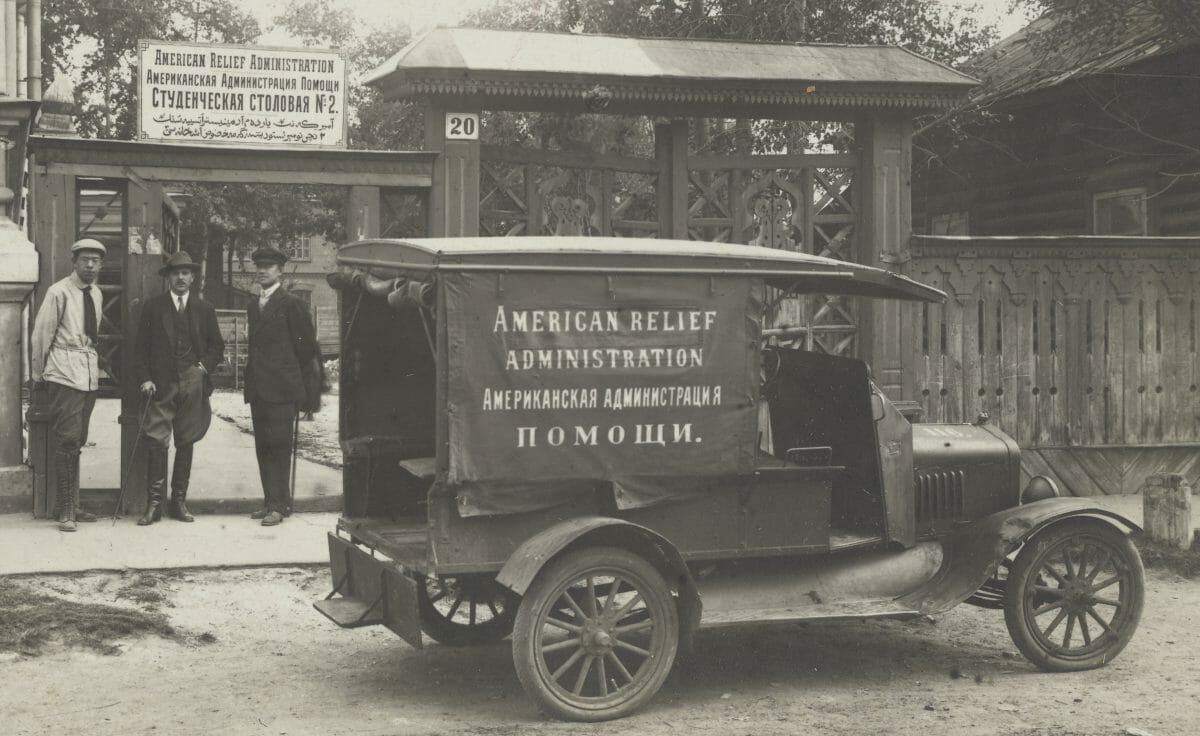
In 1921, the Russian Empire was facing a colossal crisis. The turmoil of two Russian Revolutions, civil war, and WWI gave way to peasant uprisings, grain shortages, and a government in turmoil. When drought hit, the once-formidable nation was brought to its knees by the worst famine Europe had ever known.
In July of 1921, Russian writer Maxim Gorky wrote this heartfelt appeal: "To all honest people, gloomy days have come from the land of Tolstoy, Dostoevsky...and other world-prized men...Russia's misfortunes offer humanitarians a splendid opportunity to demonstrate the vitality of humanitarianism. I ask all honest European and American people for prompt aid to the Russian people. Give bread and medicine."
Gorky's letter was published in American newspapers and caught the attention of then U.S. Secretary of Commerce Herbert Hoover. A few years before, Hoover had overseen the establishment of the American Relief Administration (ARA), a federal humanitarian agency created to help Europe in the aftermath of WWI. After reading Gorky's letter, Hoover dispatched his best ARA men to Russia at once.
For the next two years, a committed group of Americans braved unimaginable horrors to aid millions of starving Russians.
Author Douglas Smith calls the American relief effort one of the noblest acts in American history. Smith tells this compelling story in The Russian Job: The Forgotten Story of How America Saved the Soviet Union from Ruin (Farrar, Straus and Giroux, 2019).
Challenges
For years before the famine, the Russian government had taken grain from the peasants, sometimes stealing it at gunpoint. They used it to feed the troops and factory workers and to finance Russia's economic expansion.
Peasants began to hide their grain from authorities. They also reduced the size of their crops, growing only enough to feed their families—knowing that any excess would be seized. As a result, when drought struck, there was no reserve of grain.
Though his people were in desperate need of assistance, Lenin rejected America's initial offer. The ARA wanted to control the transport and distribution of food and supplies—terms Lenin could not agree to.
When the situation grew dire, Lenin finally agreed to the American's terms. By then, as many as 30 million people were starving.
Famine shock
The ARA men who traveled to Russia were young, well-educated, and, for the most part, idealistic. Many were WWI veterans, looking for another European adventure.
Whatever horrors they may have witnessed in WWI could not have prepared them for what they would encounter in Russia.
The men were mobbed by hungry people wherever they went. When they traveled by train, small children would hang outside the moving rail cars asking for food.
People ate grass, weeds, and the thatching from their roofs. They ate every animal in town, including cats and dogs. When that wasn't enough, they simply collapsed in the street and died.
When the situation was at its worst, some resorted to cannibalism. Armed guards had to watch over buildings holding the recently deceased to prevent hungry people from breaking in and stealing the corpses.
Mothers deserted their children because they could not bear to watch them suffer. Orphanages swelled with children. Facilities built to house no more than 30 were stuffed with 400 to 500 children.
Describing his visit to a children's hospital, one ARA worker wrote, "There is just enough food and heat to make their death a slow one."
The conditions they witnessed were so dreadful, the men coined the term "famine shock" (similar to shell shock in WWI) to describe their mental state.
Originally, the ARA mission was to feed one million children but soon after their arrival, they realized that the need was much greater than anticipated. The mission was revised. They would feed seven million children.
Famine shock was not the only peril the ARA men faced.
Every time they stepped out onto the street, they risked being attacked by gun-toting bandits intent on robbing them.
The Cheka, Russia's secret police and precursor to the KGB, monitored their every move.
But the greatest threat for the Americans was typhus. The disease was rampant among the starving people. Many ARA workers also contracted the disease. Some came close to death.
Accomplishments
Despite all the adversity, most of the ARA men did not regret their time in Russia. In the span of just two years, they had led the greatest humanitarian effort in history.
They fed 11 million people a day in 28,000 cities across Russia. They supplied 15,000 hospitals with medical supplies. They inoculated ten million people against infectious diseases.
Despite their best efforts, an estimated seven million people died. However, over ten million people survived, thanks to the ARA.
While the Russian people were enormously grateful to America, the Russian government did it's best to erase America's role in relief efforts.
The story is also largely forgotten in the United States. America's intense anti-communist sentiments in the middle of the twentieth century made this bit of history easy to overlook.
As Smith says in his prologue, "The Russian Job seeks to right this wrong."